
Master IGCSE Chemistry
A structured guide for stronger concepts, accurate calculations, confident practical work and precise exam answers.
Chemistry becomes easier when facts are organised around particles, structure and bonding, conservation of atoms, electron transfer, energy, quantitative relationships and experimental evidence.
Check your exact board and current specification
Cambridge IGCSE Chemistry uses 0620; Cambridge IGCSE (9–1) uses 0971 and follows the same syllabus content with a different grading scale. Pearson Edexcel International GCSE Chemistry linear uses 4CH1. Use your specification as the master checklist because assessment structures differ.
Explain states of matter with particles
Link particle arrangement, separation, motion and energy to the properties of solids, liquids and gases. When heating, particles gain kinetic energy; do not write only that they ‘move more’.
Explain diffusion using particle motion
Diffusion is the net movement of particles from higher to lower concentration due to random particle motion. Temperature affects particle speed, and lighter gas particles generally diffuse faster under comparable conditions.
Distinguish elements, compounds and mixtures
An element contains one type of atom; a compound contains different elements chemically combined in fixed proportions; a mixture contains substances not chemically combined and can be separated physically.
Master atomic structure and isotopes
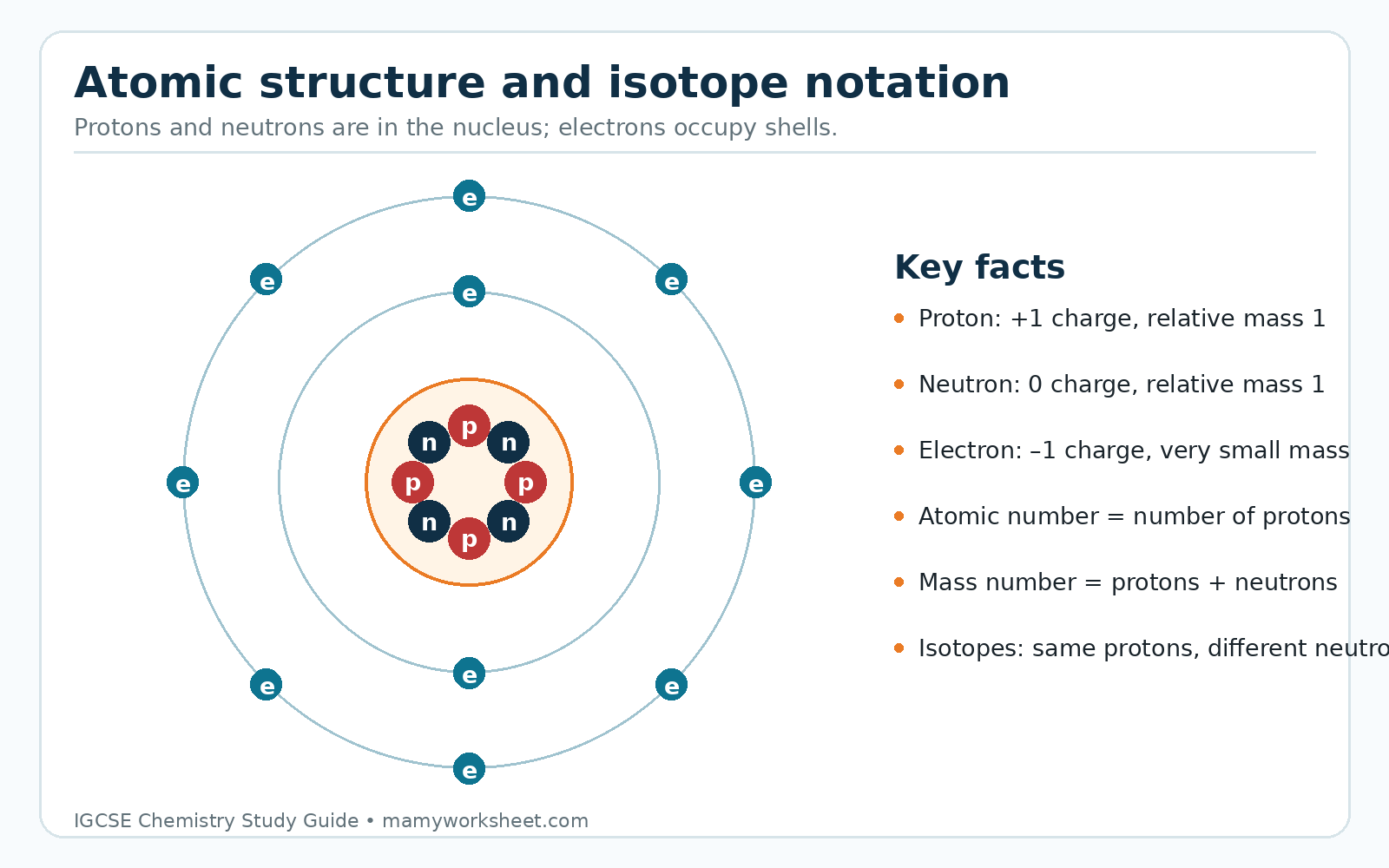
Know proton number, mass/nucleon number, relative charges and masses of subatomic particles, isotope notation and why isotopes of one element have similar chemical properties.
Use electron configurations to predict behaviour
For the first 20 elements, connect electron arrangement to group, period and ion formation. Use outer electrons to explain trends only where required by your specification.
Write formulae from ions and valencies
Construct neutral formulae by balancing total positive and negative charge. Example: Al3+ and O2− combine as Al2O3.
Balance equations without changing formulae
Change coefficients, never subscripts inside a correct formula. Check every element on both sides and add state symbols only when required.
Explain ionic bonding precisely
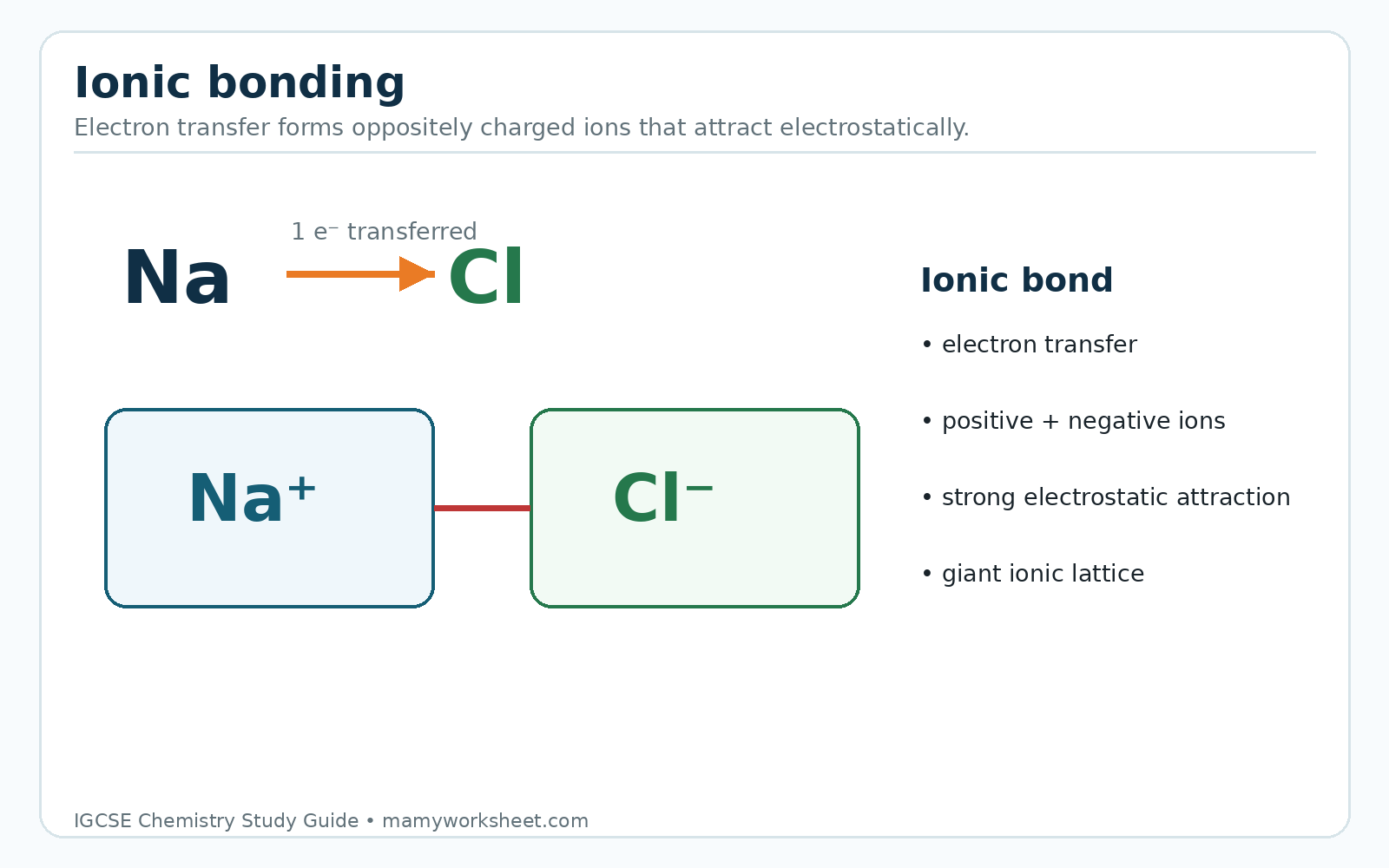
Ionic bonding is the strong electrostatic attraction between oppositely charged ions in a giant ionic lattice. Do not describe ionic bonding as electron sharing.
Explain covalent bonding precisely
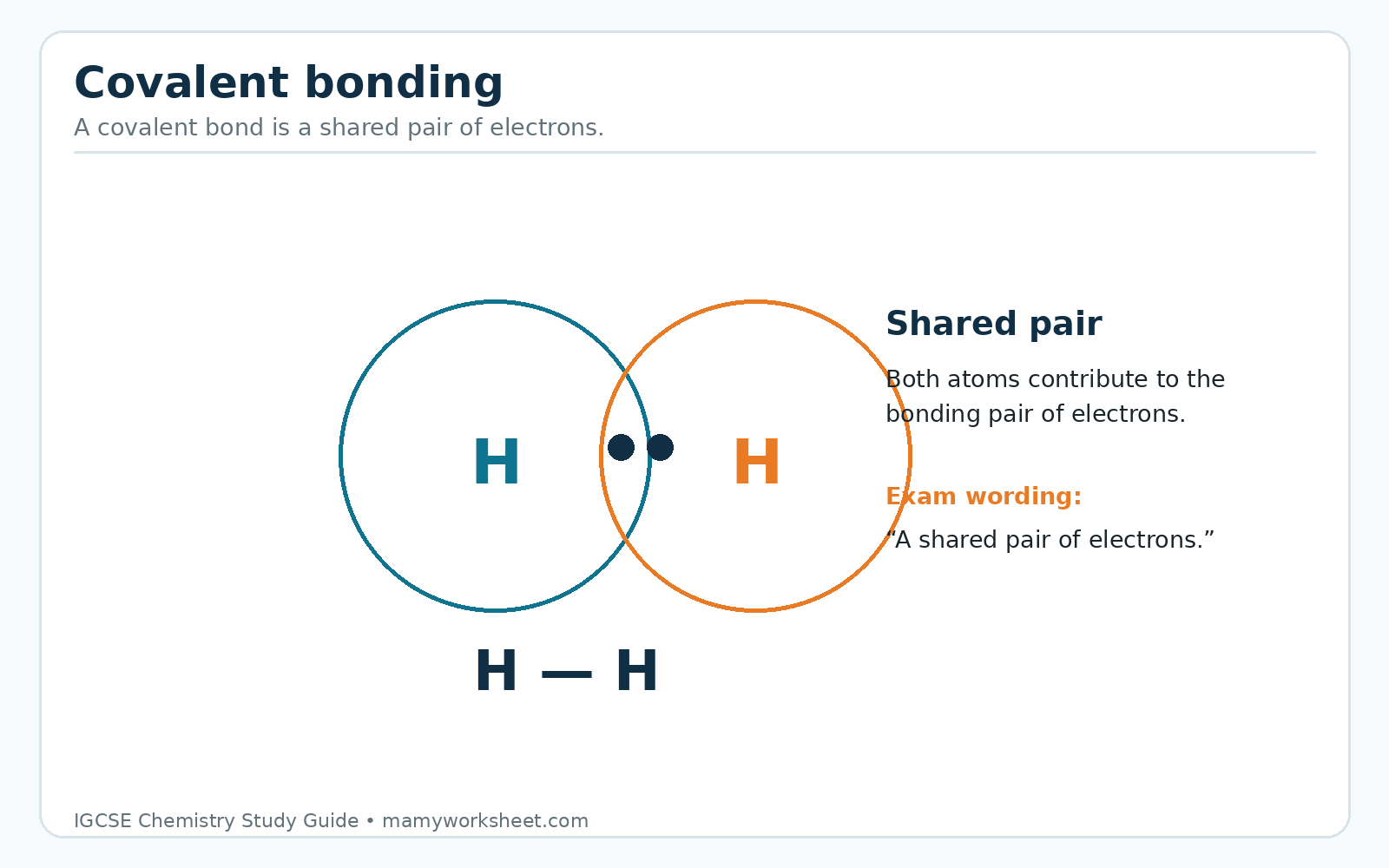
A covalent bond is a shared pair of electrons between atoms. Draw dot-and-cross diagrams carefully and show the electron information requested.
Explain metallic bonding precisely
Describe a lattice of positive metal ions with delocalised electrons and the electrostatic attraction between them.
Link structure to melting and boiling point
Identify the particles and forces that must be overcome. Simple molecular substances have relatively weak intermolecular forces; giant structures involve many strong bonds.
Explain conductivity using mobile charge carriers
Ionic substances conduct when molten or aqueous because ions can move. Metals conduct because delocalised electrons are mobile.
Compare diamond and graphite using structure
Relate bonding and structure to hardness, conductivity and uses. Graphite has delocalised electrons and layers that can slide.
Calculate relative atomic and formula mass
Add relative atomic masses according to the formula. For isotope questions, use a weighted mean from isotopic abundance.
Use moles as the central calculation step
moles = mass ÷ Mr. Convert the given quantity to moles before using the balanced-equation ratio.
Calculate moles in 9.8 g H2SO4. Mr=98.
moles = 9.8 ÷ 98 = 0.100 mol
Use stoichiometric ratios from balanced equations
Follow the chain: given quantity → moles → equation ratio → target moles → required quantity.
2Mg + O2 → 2MgO
4.8 g Mg: moles Mg = 4.8 ÷ 24 = 0.20 mol. Ratio Mg:MgO = 2:2, so MgO = 0.20 mol. Mr(MgO)=40.
mass MgO = 0.20 × 40 = 8.0 g.
Identify the limiting reactant
Compare available amounts with the stoichiometric ratio. The limiting reactant is used up first and determines the maximum product.
Calculate concentration correctly
For molar concentration use concentration = moles ÷ volume in dm3. Convert cm3 to dm3 by dividing by 1000.
0.050 mol in 250 cm³: 250 cm³ = 0.250 dm³.
concentration = 0.050 ÷ 0.250 = 0.200 mol/dm³.
Handle gas-volume calculations carefully
Use the molar gas volume required by your board or provided by the question and pay attention to stated conditions rather than inserting a remembered value automatically.
Find empirical and molecular formulae systematically
Convert masses or percentages to moles, divide by the smallest amount, scale to whole-number ratios, then use Mr to move from empirical to molecular formula when required.
24 g C and 4 g H: C = 24÷12=2 mol; H = 4÷1=4 mol. Divide by 2 → 1:2.
Empirical formula = CH2.
Calculate percentage yield and purity
% yield = actual ÷ theoretical × 100. % purity = mass of pure substance ÷ total sample mass × 100.
Theoretical yield 12.0 g; actual yield 9.0 g.
% yield = (9.0÷12.0)×100 = 75.0%.
Protect calculation marks
Show the relationship, substitution, units and intermediate working. Keep unrounded calculator values until the final answer and round sensibly.
Understand electrolysis as ion movement and electron transfer
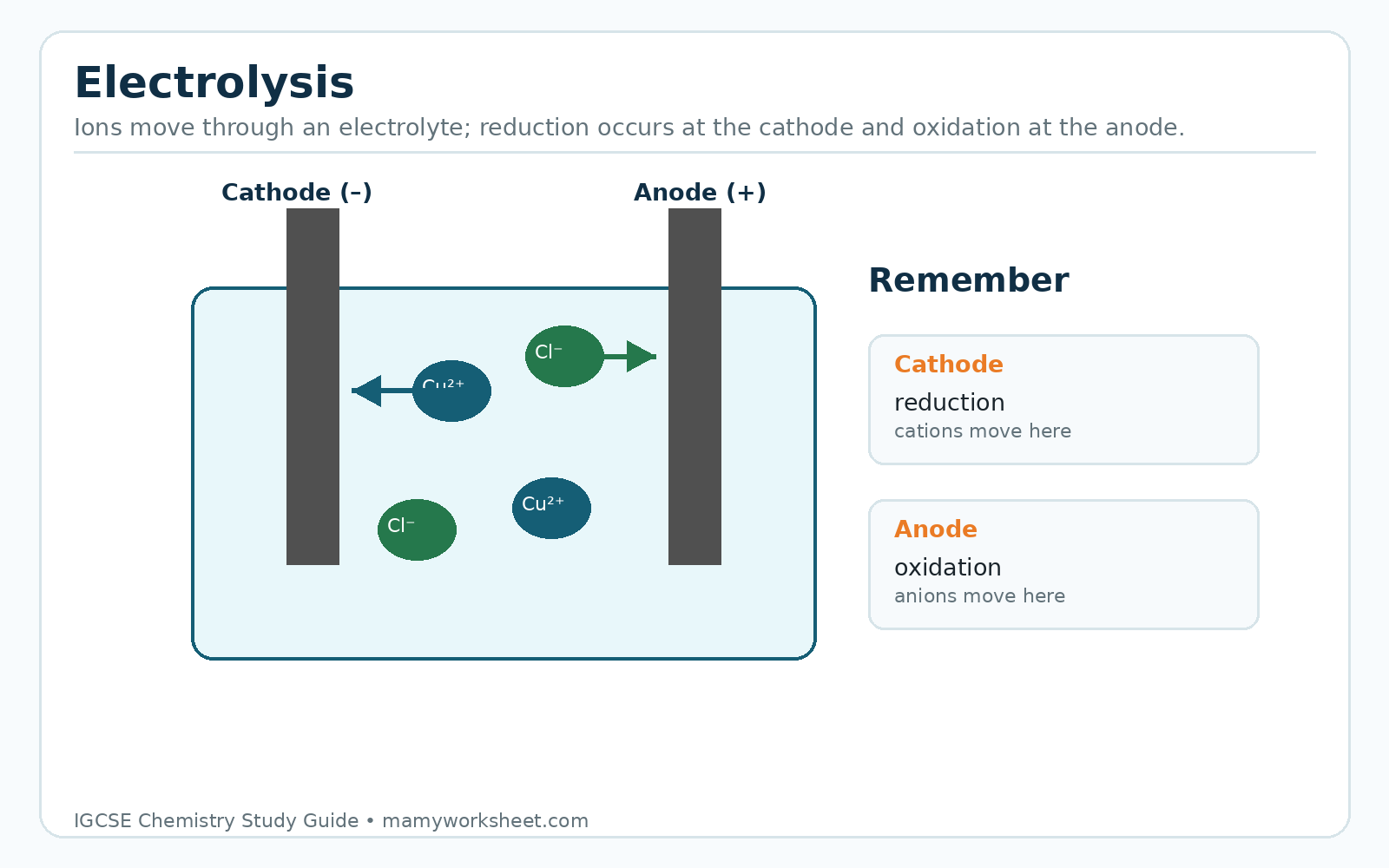
Cations move to the cathode and anions to the anode. Reduction occurs at the cathode; oxidation occurs at the anode.
Write half-equations with atoms and charge balanced
Balance atoms first, then balance charge with electrons. Check whether electrons are reactants or products.
Distinguish molten and aqueous electrolysis
Molten electrolytes contain ions from the compound only. Aqueous solutions involve water too, so the discharged products may differ.
Distinguish exothermic and endothermic reactions
Exothermic reactions transfer energy to the surroundings; endothermic reactions take in energy from the surroundings.
Interpret reaction profiles and activation energy
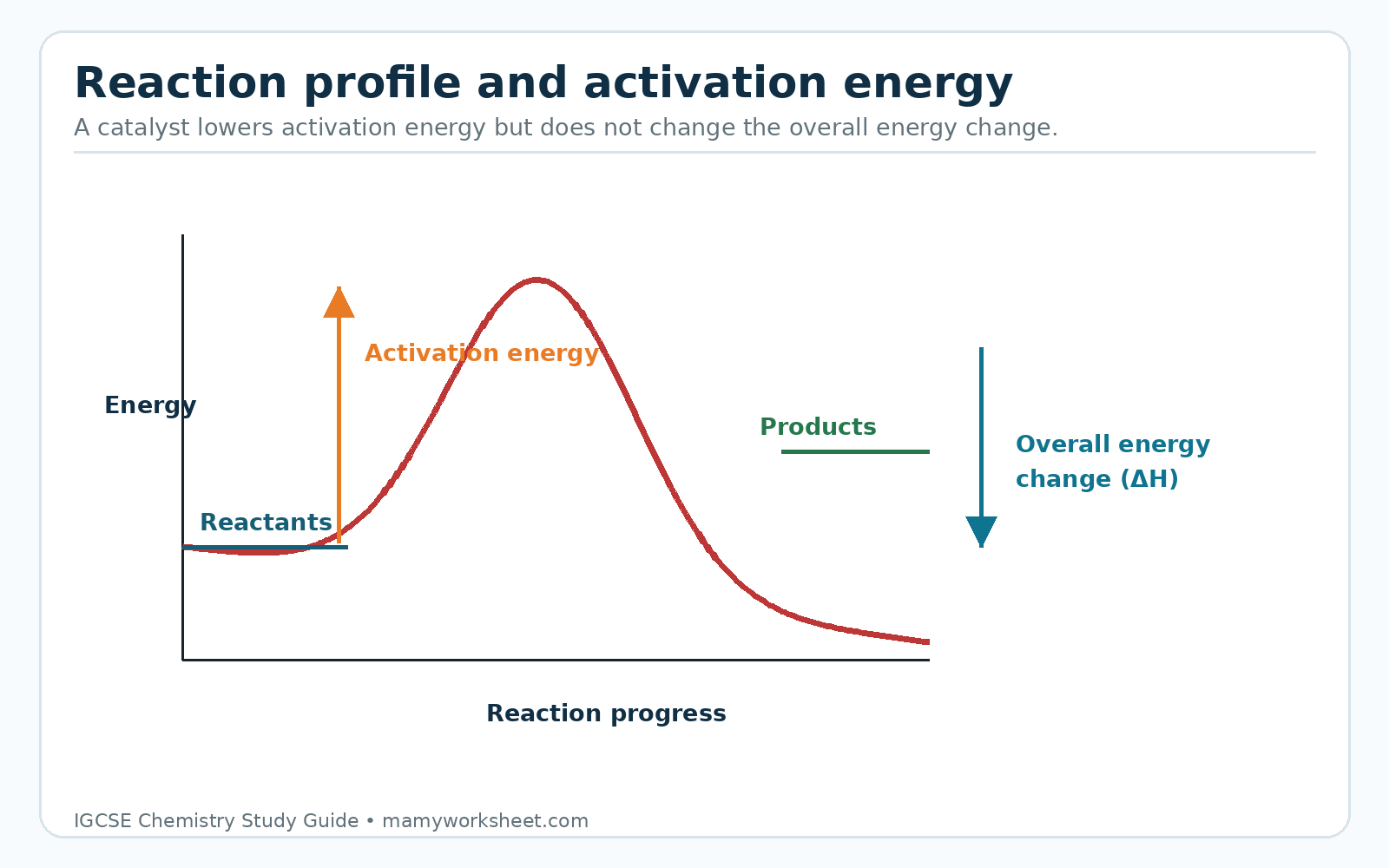
A catalyst lowers activation energy but does not change the overall energy change of the reaction.
Use bond energies with the correct sign idea
Energy change is approximated by energy required to break bonds minus energy released when new bonds form.
1. Add energy required to break reactant bonds. 2. Add energy released when product bonds form. 3. Calculate bonds broken − bonds formed.
Negative result: exothermic. Positive result: endothermic.
Explain rate using collision theory
Successful reactions require collisions with sufficient energy. Explain how temperature, concentration, gas pressure, surface area and catalysts change collision frequency or the fraction of successful collisions.
Read rate from graphs
Average rate is change in quantity divided by time. Pearson explicitly expects candidates to understand the gradient of a tangent as a measure of instantaneous rate of change.
Average rate = change in quantity ÷ time. For instantaneous rate, where required, draw a tangent at the point and calculate its gradient using two well-separated points on the tangent.
Recognise reversible reactions and equilibrium
Learn the exact equilibrium requirements for your board. At dynamic equilibrium in a closed system, forward and reverse reaction rates are equal.
Recognise oxidation and reduction
Use oxygen transfer, electron transfer or oxidation state as required by the context. In electron terms: oxidation is loss, reduction is gain.
Use acid, base and alkali accurately
An alkali is a soluble base. Use the exact acid–base definitions required by your syllabus and do not confuse neutralisation with dilution.
Interpret pH and indicators
Know the direction of acidity and alkalinity and use litmus or universal indicator appropriately.
Choose the correct salt-preparation method
The method depends on solubility and reactants: excess insoluble solid with acid, acid–alkali titration, or precipitation are common routes.
| Situation | Method |
|---|---|
| Soluble salt + excess insoluble reactant | Add excess solid → filter → concentrate → crystallise → dry |
| Soluble salt from acid + alkali | Titration → repeat exact volumes without indicator → concentrate → crystallise |
| Insoluble salt | Precipitation → filter → wash → dry |
Understand titration as a precision method
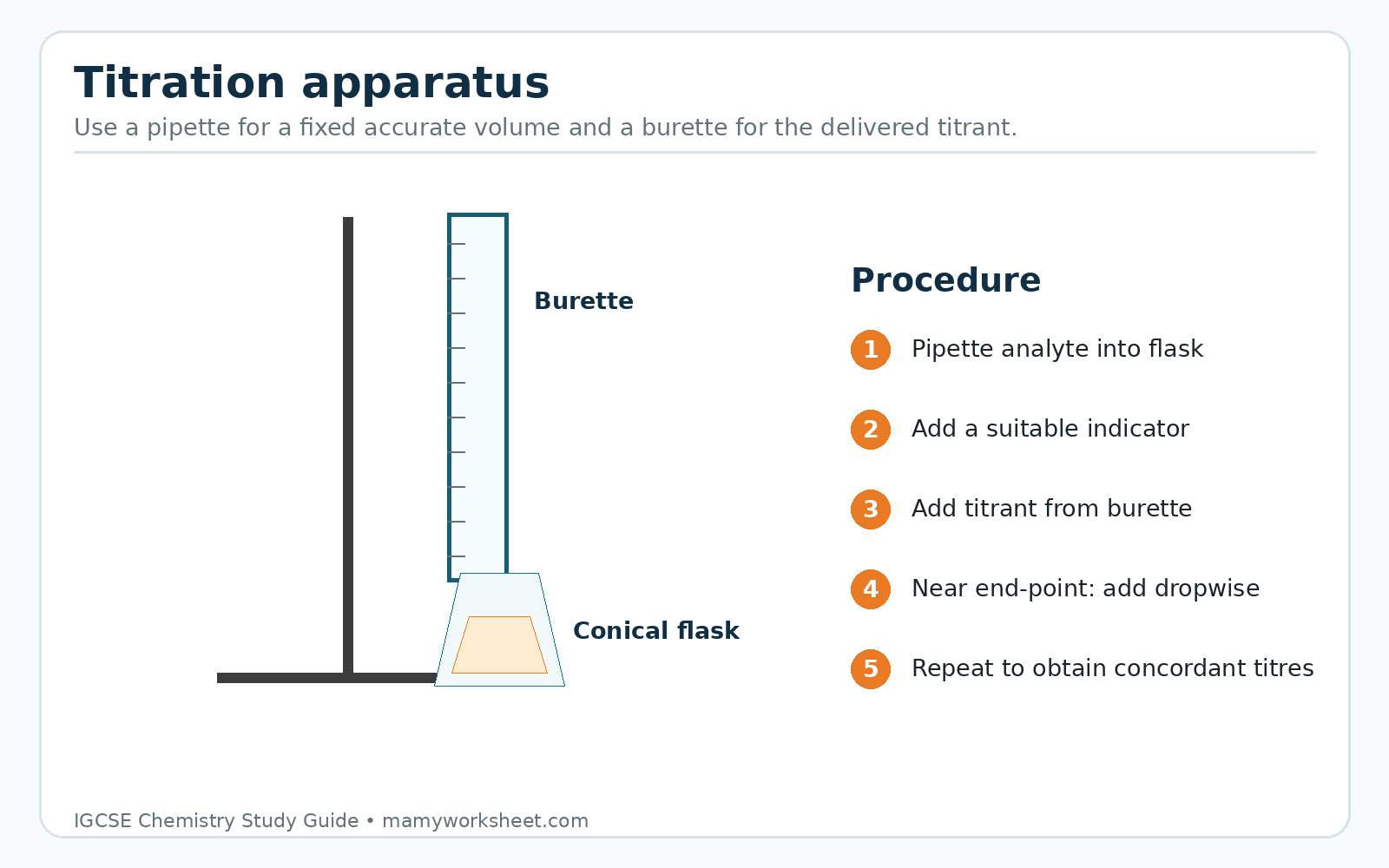
Use a volumetric pipette for a fixed accurate volume and a burette for a measured variable volume. Record readings consistently and use an indicator where appropriate.
Choose the correct separation technique
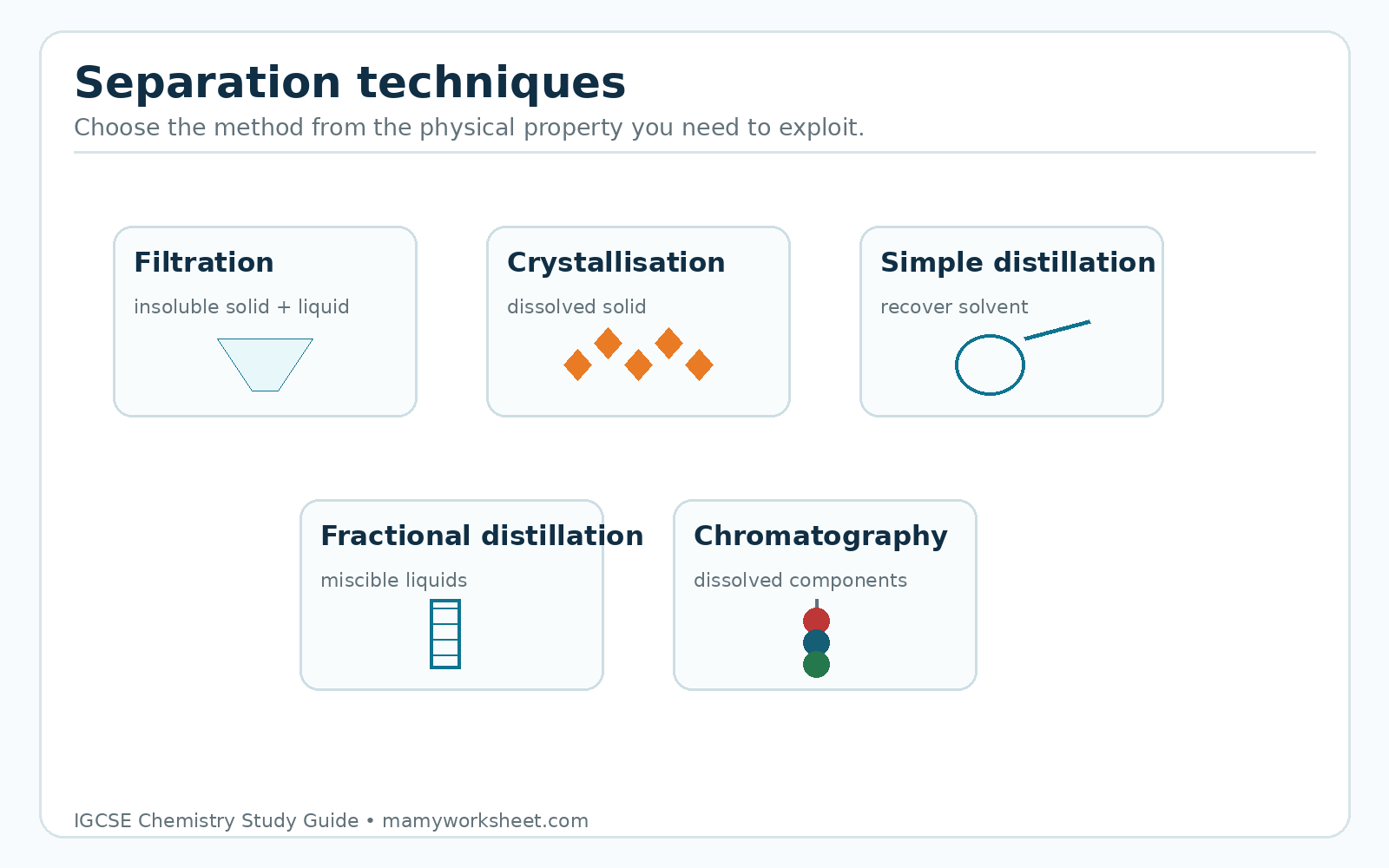
Filtration separates an insoluble solid; crystallisation obtains a soluble solid; simple/fractional distillation use boiling-point differences; chromatography separates dissolved substances.
| Method | Typical use |
|---|---|
| Filtration | Insoluble solid from liquid |
| Crystallisation | Obtain a dissolved solid |
| Simple distillation | Recover solvent / large boiling-point difference |
| Fractional distillation | Separate miscible liquids |
| Chromatography | Separate dissolved components |
Interpret chromatography
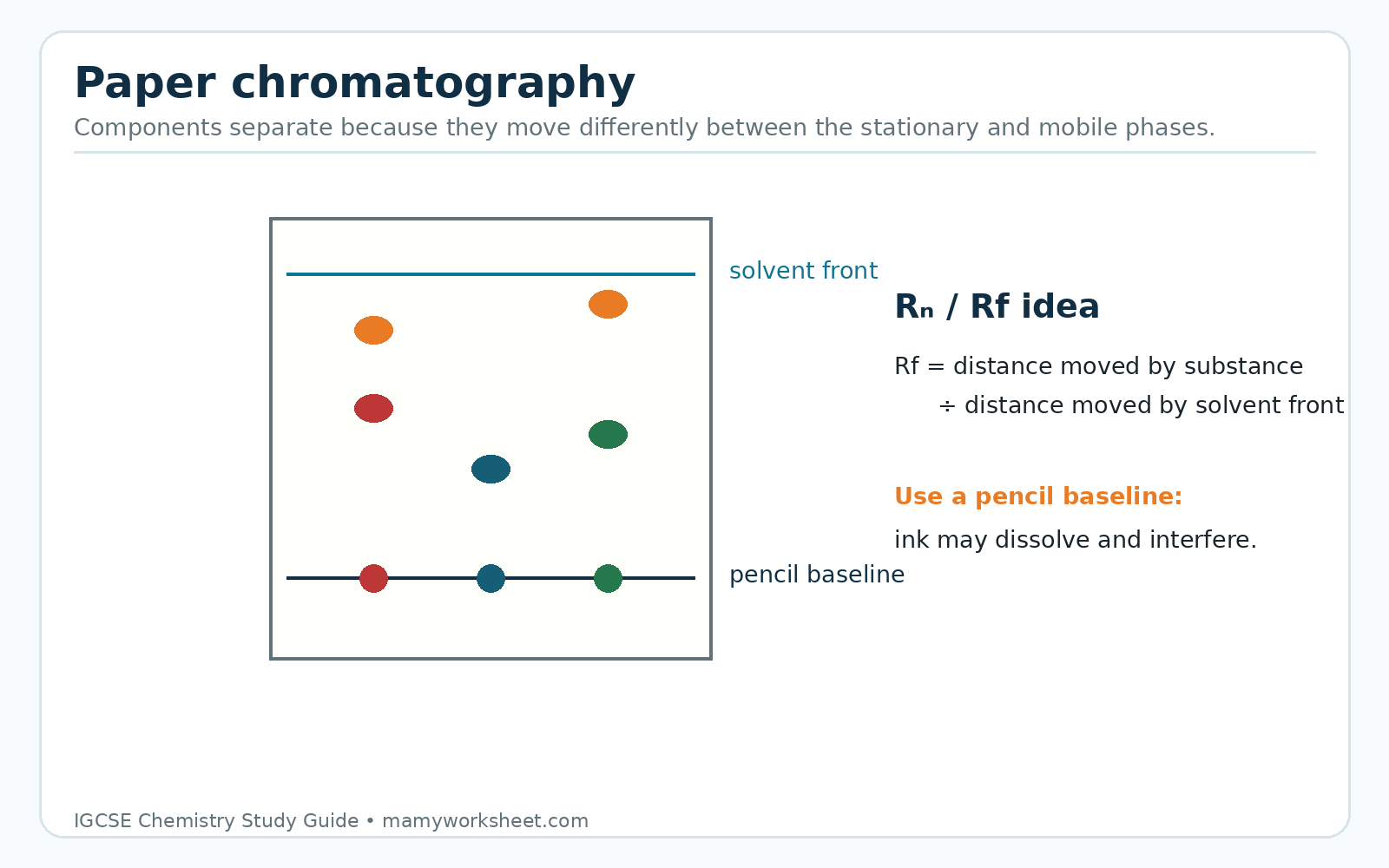
Use spot patterns to identify mixtures and, where required, calculate Rf = distance moved by substance ÷ distance moved by solvent front.
Know the classic gas tests
Hydrogen gives a pop with a lighted splint; oxygen relights a glowing splint; carbon dioxide turns limewater milky; ammonia turns damp red litmus blue; chlorine bleaches damp litmus. Cambridge also specifies sulfur dioxide decolourising acidified potassium manganate(VII).
Know required flame-test colours
For current Cambridge 0620: Li+ red, Na+ yellow, K+ lilac, Ca2+ orange-red, Ba2+ light green, Cu2+ blue-green. Check your own board list before memorising.
Use observations to identify ions
Learn the required cation and anion tests for your board. Record reagent, condition and observation, including precipitate colour and solubility in excess reagent where relevant. Cambridge provides qualitative-analysis notes in Papers 5 and 6, but interpretation still matters.
Read the Periodic Table as a pattern map
Connect group number, outer electrons and chemical behaviour. Use period number to relate to occupied shells where your board uses this model.
Explain Group 1 and Group 7 trends
Group 1 reactivity increases down the group; Group 7 reactivity decreases down the group. Link trends to electron arrangements where required.
Down the group, greater distance and shielding weaken attraction to the outer electron, so it is lost more easily and reactivity increases.
Down the group, greater distance and shielding weaken attraction for an incoming electron, so reactivity decreases.
Use displacement reactions as evidence of reactivity
A more reactive metal displaces a less reactive metal from its compound; a more reactive halogen displaces a less reactive halide from solution.
Recognise transition-element behaviour
Common syllabus ideas include variable oxidation states, coloured compounds and catalytic activity; use only the examples required by your specification.
Use the reactivity series to predict reactions and extraction
Apply relative reactivity to water/steam, dilute acids and displacement reactions. More reactive metals generally require electrolysis for extraction; less reactive metals may be reduced chemically.
Understand rusting and corrosion
Rusting of iron requires oxygen and water. Explain barrier protection or sacrificial protection by the process it prevents or redirects.
Connect environmental chemistry to chemical processes
Study the board-specific causes, effects and controls of pollutants, water treatment and atmospheric chemistry. Base explanations on chemical reactions and evidence.
Use homologous-series patterns
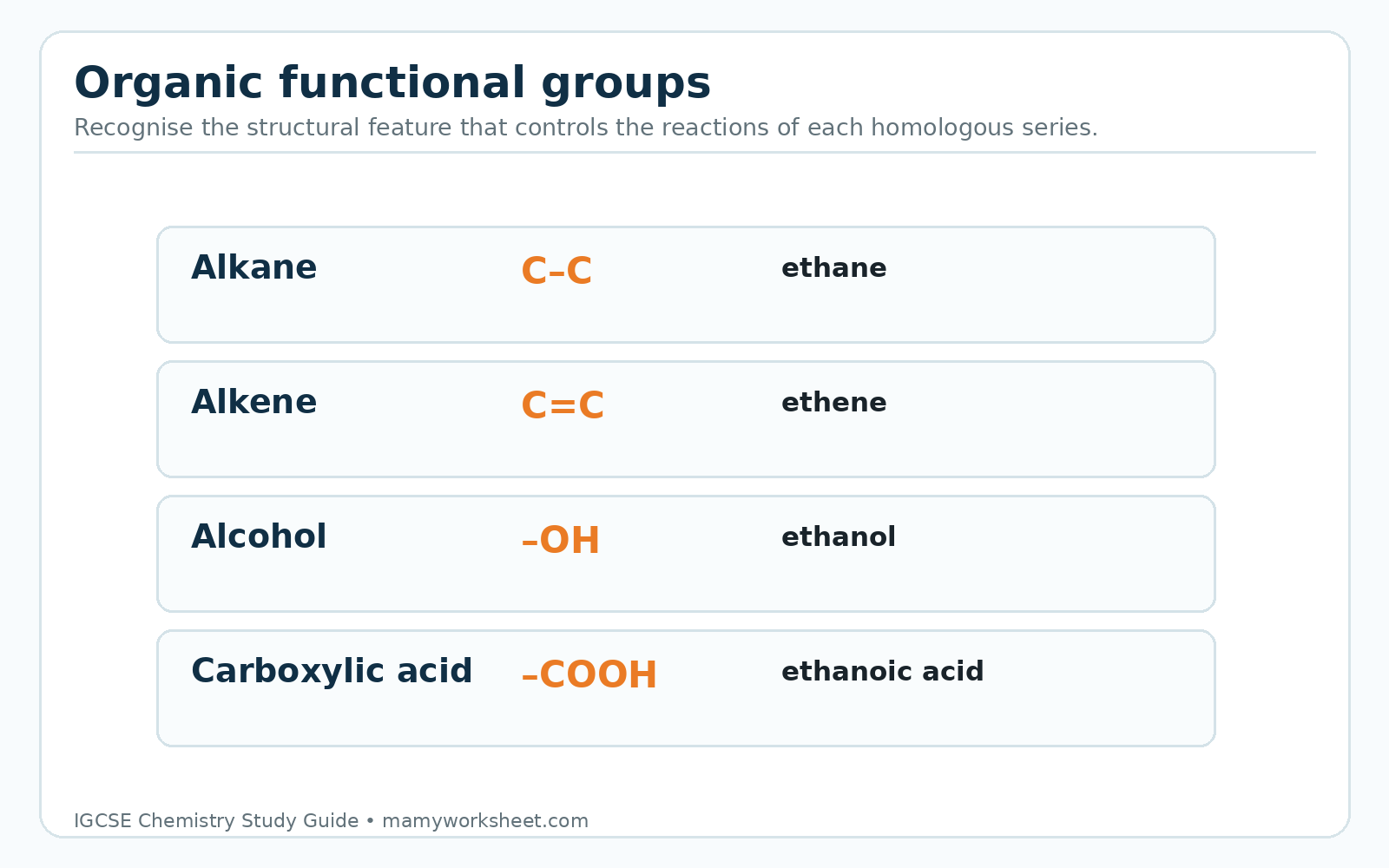
Recognise required functional groups, general formulae, names and structural/displayed formulae. Requirements differ between boards.
| Family | Key feature | Formula / group | Example |
|---|---|---|---|
| Alkanes | Saturated | CnH2n+2 | Ethane |
| Alkenes | C=C | CnH2n | Ethene |
| Alcohols | –OH | hydroxyl group | Ethanol |
| Carboxylic acids | –COOH | carboxyl group | Ethanoic acid |
Understand alkanes as saturated hydrocarbons
Relate single C–C bonds to saturation and learn required combustion and substitution chemistry.
Use the C=C bond to predict alkene reactions
Alkenes are unsaturated and undergo addition reactions. Bromine water is commonly used to test for unsaturation.
Alkenes undergo addition reactions across the C=C bond. Bromine water is decolourised by an alkene and is used as a test for unsaturation.
Connect ethanol preparation, reactions and uses
Distinguish fermentation and hydration routes where required, including specified conditions and advantages/disadvantages.
Uses sugars and microorganisms under suitable conditions and produces ethanol in an aqueous mixture.
Uses ethene and steam under specified industrial conditions and is a rapid continuous process.
Recognise carboxylic-acid chemistry
Use the –COOH functional group and connect its acidic behaviour to reactions specified by your syllabus.
Differentiate addition and condensation polymerisation
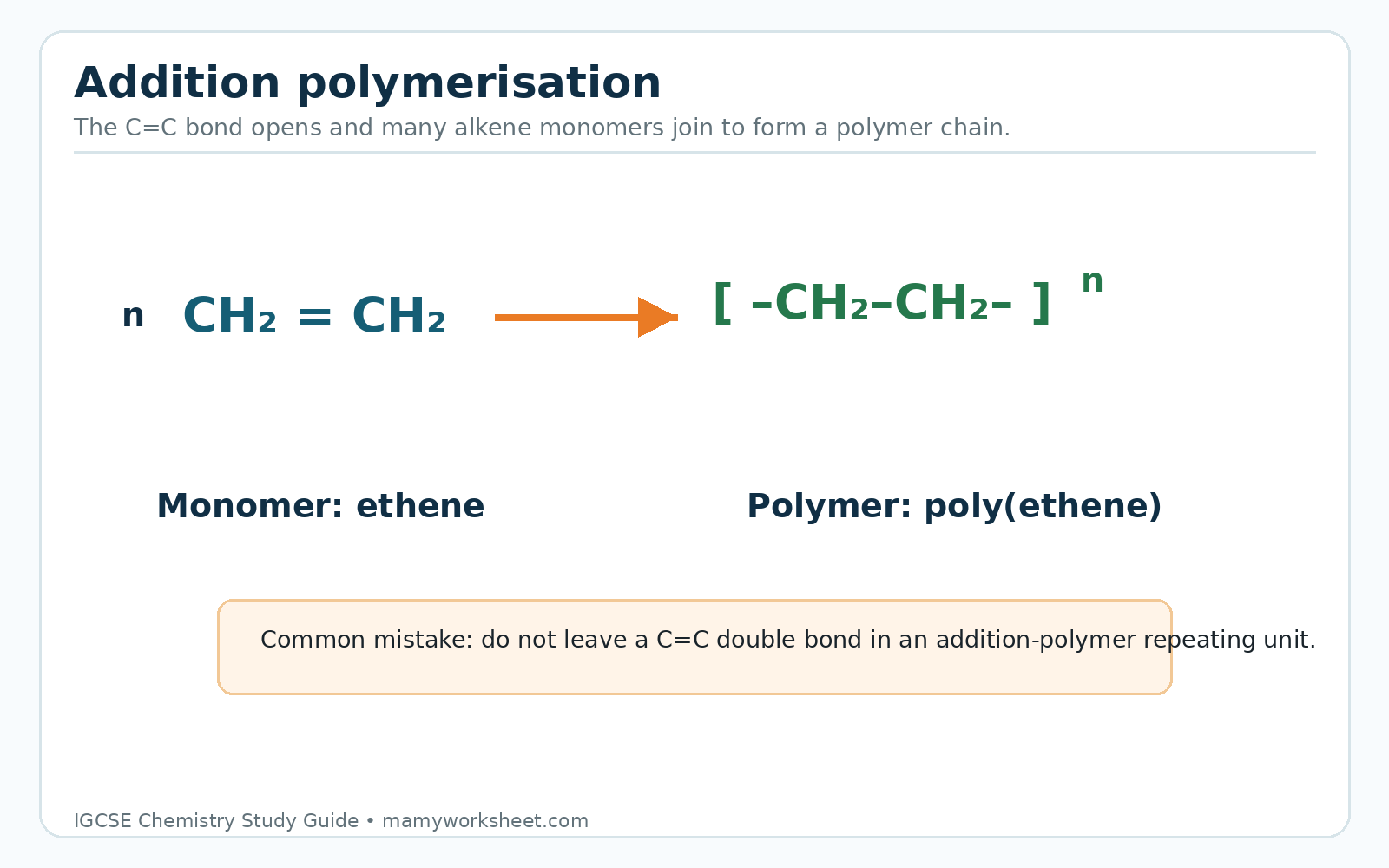
Addition polymerisation opens C=C bonds with no small molecule eliminated. Condensation requirements vary by board, so follow your exact specification.
The C=C bond opens and many alkene monomers join. The repeating unit keeps the monomer's atoms and side groups.
Select apparatus for precision
Choose apparatus to suit the measurement. Burettes and volumetric pipettes give more precise volume measurements than routine measuring cylinders.
| Task | Apparatus | Reason |
|---|---|---|
| Accurate fixed volume | Volumetric pipette | Accurate specified volume |
| Accurate variable volume | Burette | Accurate delivered volume from initial/final readings |
| Routine volume | Measuring cylinder | Convenient but less precise |
| Mass | Balance | Read to instrument precision |
Define independent, dependent and control variables
State exactly what is changed, what is measured and what must be controlled for a fair test.
Choose a useful range and enough values
Use a range broad enough to reveal a trend and enough values to support a graph or conclusion.
Use repeats to improve reliability
Repeat measurements, identify anomalies only with evidence and calculate a mean from suitable results.
Match improvements to real limitations
Name the equipment or procedural change and explain how it reduces uncertainty or controls a variable; avoid vague phrases like ‘be more accurate’.
Write specific safety precautions
Match the precaution to the hazard. For example, corrosive or irritant chemicals justify eye protection and careful handling.
Separate observations from inferences
Observation: colour change, precipitate, gas, temperature change. Inference: what species or process the observation suggests.
Design tables and graphs before interpretation
Put the independent variable first, units in headings, consistent precision in measurements, and sensible graph scales with labelled axes.
Evaluate data and method
Identify limitations, explain their effect, distinguish random variation from systematic error when appropriate, and suggest a specific improvement.
Limitation: heat is lost to surroundings.
Effect: measured temperature change is smaller than the true value.
Improvement: use an insulated container with a lid.
Transfer practical skills to unfamiliar methods
Cambridge explicitly expects experimental skills to be applied in unfamiliar situations. Read the apparatus and data, then apply the underlying principle.
Answer the command word
Cambridge 0620 currently includes command words such as analyse, calculate, compare, contrast, deduce, define and describe; Pearson publishes its own command-word taxonomy. Learn your board’s meanings.
Separate describe from explain
Describe states what happens or the pattern shown. Explain gives the scientific reason or mechanism.
Describe: The rate increases as temperature increases.
Explain: At higher temperature particles have greater kinetic energy, so a greater proportion of collisions have sufficient energy to react.
Compare directly
Use paired comparison statements instead of two separate descriptions.
Use numerical evidence
When a graph or table is supplied, quote relevant values with units to support trends and conclusions.
The temperature increased a lot.
The temperature increased from 21 °C to 34 °C, a rise of 13 °C.
Apply known chemistry to unfamiliar contexts
Identify the principle first—particles, bonding, redox, stoichiometry, rate, equilibrium or practical design—then apply it logically.
Progress from topic questions to timed papers
Start with topic practice, then mixed questions, then complete papers under timed conditions.
Use mark schemes as diagnosis
Identify the missing scientific idea, not only the missing phrase. Keep a mistake log for recurring errors.
Use flashcards for recall-heavy content
Flashcards work well for tests, definitions, conditions, colours, formulae and trends; calculations need worked practice too.
Practise equations frequently
Short daily practice with balancing, ionic equations and half-equations improves speed and accuracy.
Run a final chemistry check
Check formulae, charge, balancing, units, state symbols, significant figures, graph labels and whether the conclusion is supported by the evidence.
✅ Chemistry Exam Checklist
Cambridge vs Pearson: use the guide correctly
| Area | Cambridge 0620 / 0971 | Pearson Edexcel International GCSE Chemistry |
|---|---|---|
| Course | 0620 and 0971 share syllabus content; 0971 uses 9–1 grading. | Linear and modular routes are currently available; modular is available outside the UK. |
| Practical assessment | Paper 5 Practical Test or Paper 6 Alternative to Practical alongside theory papers. | Experimental understanding is assessed in written examinations; organisation depends on linear/modular route. |
| Golden rule | Never transfer board-specific paper structures, lists or required conditions without checking the current specification. | |
Sources used to verify this guide
Primary specifications:
Cambridge IGCSE Chemistry 0620
Cambridge IGCSE (9–1) Chemistry 0971
Pearson Edexcel International GCSE Chemistry
Teaching/revision cross-check: Cambridge Resource Plus, Cambridge endorsed resources, Save My Exams and Physics & Maths Tutor. Official specifications take priority if a secondary source differs.
The Chemistry Routine That Builds Marks
Learn the idea, represent it chemically, calculate it, test it against evidence and practise it in exam questions.
Understand → Represent → Calculate → Apply → Evaluate → Correct